

A Tale of Two ARCAs

Within the confines of Lime Rock Park, pose a question about ARCA, the Automobile Racing Club of America, and you’re likely to get distinctly different answers.
Friday’s lead-off race for the LIUNA 150 weekend will be the ARCA MENARDS Series Lime Rock 100. In last year’s inaugural ARCA race at The Park Thomas Annunziata turned in a masterful performance to overcome a ride off into plush grass to prevail over NASCAR Europe standout Alon Day, who had to race from the tail end of the field after a pit stop miscue.
But what is NASCAR’s ARCA series, and where did it come from?
John Marcum was a Midwesterner who embraced the vision of Big Bill France to promote racing for American sedans on short oval tracks that dotted America in the years following World War II. He formed a group initially known as MARC, the Mid America Racing Club (and a clever anagram of his name). In the mid 1960s, with NASCAR stock car racing rising in prominence Bill France invited Marcum’s group to expand by becoming a preliminary event on the high banks of Daytona International Speedway for the annual February Speed Weeks. For competitors accustomed to tiny bullrings this was a whole new world. As legend has it, France also suggested Marcum look for a name more fitting to this dramatic expansion. The Automobile Racing Club of America,ARCA, had a compelling ring.
Over the years, ARCA would indeed grow in stature, combining a base schedule of Midwest short track races with not only a regular fixture at Daytona, but expansion to other superspeedways such as Talladega, Pocono, Michigan and Kansas. And in time road course racing would also join the schedule. In 2018 NASCAR added the ARCA series to its portfolio.
ARCA has been instrumental as a stepping stone for an impressive array of drivers whose names have become headlines, from Benny Parsons and Kyle Petty all the way to Chris Buescher, Parker Kligerman, Chase Briscoe and Ty Gibbs, just to scratch the surface.
ARCA occupies a unique distinction in the world of stock car racing as the only series that races on paved short tracks, superspeedways, road courses and dirt tracks (the iconic one-mile fairgrounds at Duquoin and Springfield Illinois). Lime Rock Park is proud to be part of the modern ARCA family.
But that’s only half of the ARCA story. To really start at the beginning we need to travel back nearly a century, to the mid 1930s.
In a period of high contrast, while much of the country was feeling the effects of the Great (Economic) Depression, a cohort of what might be called “well to-do” young men were taking an interest in European style auto racing, which at that time took place on temporary circuits set up on regular roads, in contrast to what was then the distinctly American version, which focused on dirt surface fairgrounds, and culminating in the massive brick oval that was the Indianapolis Motor Speedway..
Long on enthusiasm though modest in numbers, what began as informal summer contests on the grounds of several private estates soon transformed. Though rare, suitable cars were brought over from Europe (a major undertaking in itself in the days before technology we have come to take for granted, from fax machines to the internet). With some useful connections in local politics, in 1934 a 3.3 mile circuit using roads around Briarcliff, New York brought the group, now officially constituted as the Automobile Racing Club of America, into the public limelight.
Over the ensuing six years ARCA would return to Briarcliff, climb the daunting Mount Washington, race around the houses in Alexandria Bay, New York, travel to the tip of Long Island to take advantage of roadways that would eventually become a housing development in Montauk Point, and culminate their pioneering spirit with an improbable contest on the grounds of the New York World’s Fair in 1940. Then, with war clouds on the horizon ARCA suspended their endeavors and signed off with a letter from the group’s leader, George Rand, Lieutenant J.G. US Navy, on December 9, 1941.
To bring our ARCA connections into a full circle along with this year’s ARCA MENARDS Lime Rock 100, the original ARCA group will have a place of prominence at the 44th edition of Lime Rock Park’s Historic Festival during Labor Day weekend. While we no longer enjoy the company of ARCA’s pioneer drivers, a number of cars from that era are still going strong, including the Ford-based Old Gray Mare that Lem Ladd drove to victory at A’Bay and Montauk, now in the hands Ben Bragg, and a Type 37 Bugatti that even in the rarified world of the French automotive icon is one- of-a- kind (which you can discover for yourself in the HF44 paddock), enthusiastically campaigned by Sandy Leith.

(Here’s the Bugatti leading the Old Gray Mare on the streets of Alexandria Bay, New York — Sandy Leith Archives)
Though the original ARCA existed for only a brief period, its members helped lay the foundation for American road racing long before tracks like Lime Rock Park existed. Nearly a century later, that legacy lives on.
This July, ARCA returns to Lime Rock Park in the form of NASCAR’s next generation of rising stars. This Labor Day weekend, Historic Festival 44 offers a chance to experience where part of that story began.
Two ARCAs. Two eras. One remarkable connection to American racing history. We invite you to both race weekends to compare this unique period of American racing history in real life.
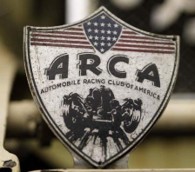
(thanks to Ed Hyman for the photo of the original ARCA badge)
Related